Agritech · 24 Oct 2026
Delisted, yet betting 20,000 sq m: Artisan Green's contrarian wager
From one tonne a month to 79, with a 3.5-year payback — an indoor farm taken off supermarket shelves shows its arithmetic
A delisted farm is building 20,000 sq m
In July 2026, Singapore's largest supermarket chain, FairPrice, pulled locally grown vegetables from at least three farms off its shelves: Artisan Green, SG Veg Farms and Netafarm. Local greens were only ever a corner of the shelf, so this was not big news.
Three months after the news, the first name on that delisting list, Artisan Green, is building a 2-hectare, 20,000 sq m farm at Sungei Tengah — more than sixty times the size of its current 300 sq m farm in Kallang. The plan: 79 tonnes of vegetables a month.
A WeChat Channels video posted on 16 September summed it up in one line: “delisted by the supermarket, still betting on a 20,000 sq m new farm”. The clip has no captions or narration, so I went back to the original reporting behind it — and the numbers are worth more than the headline.
1. First, who this company is
Artisan Green was founded in 2018 by Ray Poh, who had worked in Macau's casino industry before crossing over into indoor hydroponics, growing mainly baby spinach. The first farm, in Kallang, was 3,200 sq ft (about 300 sq m), and the whole setup cost him just under S$1 million.
In 2020 the farm produced roughly 100 kg of greens a week. By 2023 it was supplying 41 supermarkets; technically it claims to use 90% less water than soil farming and no pesticides at all.
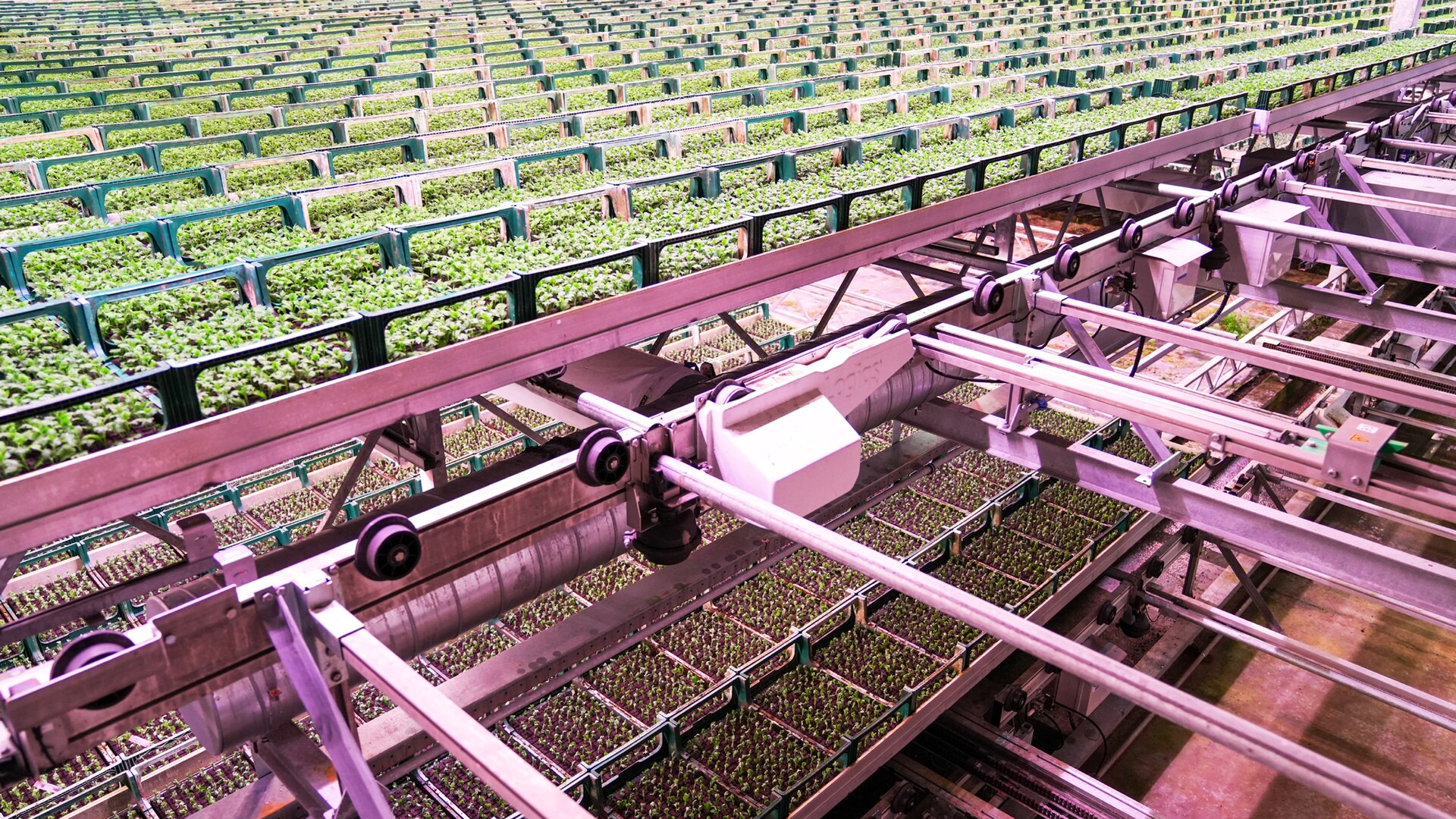
Then comes the new farm: 28G Sungei Tengah Road, 2 hectares. The design combines indoor vertical farming with outdoor growing — 30.16 tonnes a month indoors, 48.86 tonnes outdoors, 79 tonnes a month in total, or roughly 948 tonnes a year. Against today's 1 tonne a month, that is a 79-fold jump. Poh says he is confident of breaking even in about three and a half years.
2. Why it was delisted: a 50-cent gap
The reason is not quality but price. A supermarket survey by NUS Business School in September 2026 found SG Farmers' Market — the collective brand of local farms — selling xiao bai cai and chye sim at about S$0.89 per 100 g, against roughly S$0.41 for the same weight imported from Malaysia and China — local greens cost 117% more, about fifty cents more per 100 g. They call it the “50-cent price gap”.
The gap can be wider still. Greenphyto, which opened in January and bills itself as the world's tallest indoor vertical farm — S$80 million, 23.3 metres, five storeys — has first-year output of 200 tonnes against a designed 2,000. Its kailan sells at FairPrice for S$1.68 per 100 g, against S$0.44 to S$0.70 for Chinese imports — still 2.4 to 3.8 times the imported price, even after roughly a 15% cut since opening.
That explains FairPrice's decision: supermarkets make money on volume, and a pack priced more than double is a shelf space that does not turn. Delisting is not a verdict on the product; it is the arithmetic not yet working.
3. The numbers side by side
Artisan Green's key numbers
- Founded 2018; first farm in Kallang, 3,200 sq ft (about 300 sq m), cost just under S$1 million
- Current output: about 1 tonne/month (roughly 100 kg/week in 2020)
- New farm: 2 ha (20,000 sq m), 28G Sungei Tengah Road, due Q1 2027 (originally 2025)
- New output: 79 t/month = 30.16 t indoors + 48.86 t outdoors; about 948 t/year, 79× today
- Payback expectation: about 3.5 years
- Distribution: 41 supermarkets in 2023; delisted by FairPrice in July 2026, still sold at Cold Storage, Little Farms, Meidi-ya, Ryan's Grocery and RedMart
The backdrop of this business in Singapore
- Farmland is under 1% of the country; vegetable self-sufficiency is about 3%
- “30 by 30” was retired in November 2025; the new goal is fibre self-sufficiency from 8% (2024) to 20% by 2035
- Eggs 34.4% self-sufficient (local eggs cost about 12% more and still sell); seafood 6.1%
- The first tranche of the Agri-food Cluster Transformation Fund put S$55 million into nearly 150 projects, yet vegetable output has fallen since 2021
- 2026 farmland tender: two vegetable plots drew five bidders; the Lim Chu Kang parcel got a single bid
The exits are easy to list: IFFI took money from the 30×30 Express grant in 2020 (S$39.4 million shared by nine companies), built a 3,500 sq m facility in Tuas in 2021, and closed for good in 2024; Sky Greens, after more than a decade, tore down most of its greenhouses in 2024; Growy, which had received SFA funding, ran into financial trouble within a year and went into liquidation in 2025.
4. Why he is betting anyway
Poh's explanation is plain: those farms failed because they put in big money without building sales channels, so they could not recover it; our produce has already built demand, backed by market data.
That holds up in the data — it was delisted by FairPrice, but is still sold at Cold Storage, Little Farms, Meidi-ya, Ryan's Grocery and RedMart. In other words, it lost one channel, not all of them.
The second move matters more: of the new farm's 79 tonnes, only 30 come from indoor vertical growing; nearly 49 come from outdoors. In Poh's words: “even before the Middle East situation pushed up operating costs, we had already decided outdoor cultivation should be part of the new farm's design.” In other words — he capped the most expensive part (LEDs and air-conditioning) at about 40% and let sunlight carry 60% of output. That is less a triumph of vertical farming than vertical farming bowing to arithmetic.
The cost structure explains why the sector is so hard. Farmland is under 1% of Singapore, so space alone is expensive; labour is expensive, and so is equipment depreciation. The heaviest line for an indoor farm is electricity: LEDs instead of sunlight, air-conditioning instead of monsoons, and every kilogram of greens carries a power bill. Local growers say that when Middle East tensions pushed energy prices up, indoor farms felt it more sharply than others — because energy is a far bigger share of their costs.
So those 49 outdoor tonnes are not just a product-mix adjustment but a cost-structure adjustment. Sunlight is free, and so is the rain the monsoon brings — in a city-state where power tariffs only rise and wages only rise, the technology that can skip both is the sustainable one. It also explains why Artisan dares to quote a three-and-a-half-year payback: not because it made indoor farming cheaper, but because it did less of it.
5. My take
First, this is not a bet on technology but on channels. He dares to commit 20,000 sq m not because of better lights but because of one piece of market data: people already buy his greens. For anyone in controlled-environment agriculture, that sentence outweighs any technical specification — orders before capacity.
Second, the indoor-plus-outdoor mix is an honest signal. A company with “vertical farm” on its signboard handing 60% of output to sunlight is not an embarrassment; it is a correction. Under Singapore's power and labour costs, an all-indoor model struggles to beat Malaysian open-field greens on unit cost; only two things win — extreme freshness, and things imports simply cannot grow. Artisan's 49 outdoor tonnes are the first of those.
Third, eggs are the best comparison. Local eggs cost 12% more and still sell, at 34.4% self-sufficiency; local greens cost 117% more and get pulled. The difference is not agronomy but whether the premium can be felt: a half-boiled egg is ruined by a day, while greens stir-fried lose the distinction entirely. So the vegetable route is not “more advanced” but “more wanted” — either bring the premium under 20%, or make freshness irreplaceable.
Fourth, for Singapore as a whole this is a healthy clearing-out. “30 by 30” retired in 2025, farmland tenders are lukewarm, vegetable output is down — all of it sounds like bad news. But most of those exiting were projects launched on grants that never built a channel; what remains are companies like Artisan that expand after demand and dare to state a 3.5-year payback. When a sector moves from policy-driven to order-driven, the short-term numbers look worse and the long-term footing gets firmer.
Source note: this piece draws on the video's public title and hashtags, plus Lianhe Zaobao (25 Apr 2026), The Straits Times (10 Jul 2026), The Business Times, the NUS Business School “50-cent price gap” analysis (Sep 2026), SFA's Singapore Food Statistics 2025 and The Industry Index (Jul 2026). The video has no captions or narration; no footage is reproduced. Images are licensed Wikimedia Commons files, credited. Original video: https://weixin.qq.com/sph/Ar6Z1z6v1q
Also weighing the urban-farming arithmetic?
We keep tracking Singapore's CEA, its cost structure and its channels — happy to compare notes.