Company News · 21 Oct 2026
A Codex briefing in Suntec City: turning scattered records into usable files
One person’s records, one company’s data — four moves that show where AI actually lands.

One slide in the room
Today I attended a Codex briefing in Suntec City, Singapore. Codex is OpenAI’s coding agent, but the presentation was not about how much code it can write. It was about a plainer question: how do you hand a person’s records — or a company’s data — to a tool like this, and get speed without accidents?

The slide was titled “Turning scattered records into files”, marked “use: Codex · local files”. Four steps, written plainly:
- Export chat logs and orders into one folder;
- Replace names and phone numbers with client codes (C001…), keeping the mapping table on your own machine;
- Have it organise the data by the fields of your file table;
- Spot-check a few rows against the original records.
Beside it: “tell it clearly” — which columns the table has, how to recognise the same client, how to mark missing information. And at the bottom, a red box: “When you are done, do not delete the original records. Keep them for checking.”
Two more slides, two ends of the same thread
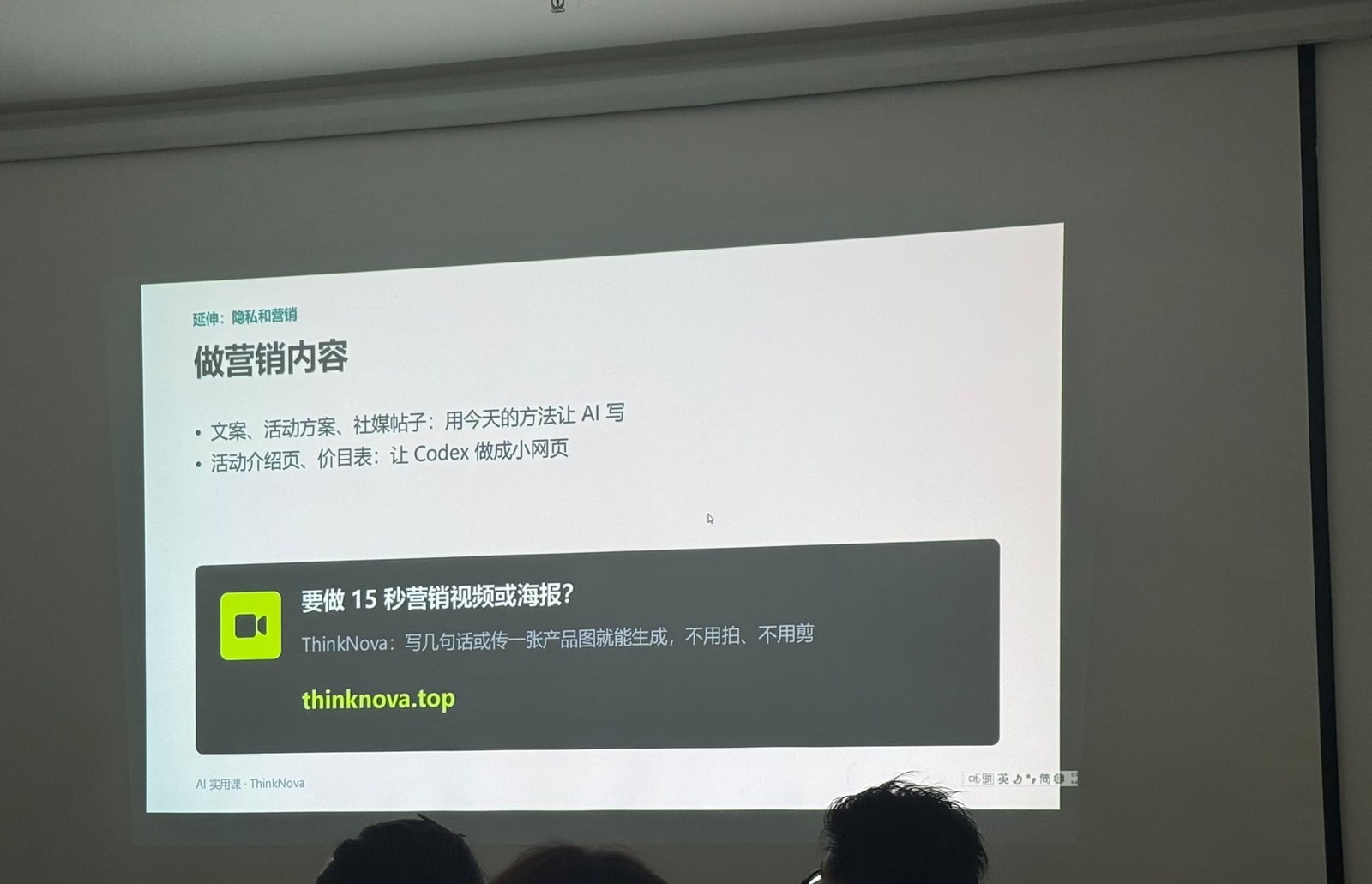
One slide was “making marketing content”: copy, campaign plans and social posts written by AI; event pages and price lists built by Codex as small web pages. A tool called ThinkNova was also shown, turning a few sentences or one product photo into a 15-second video or poster — no shooting, no editing.
Another slide was more practical — a prompt you can copy outright: build a single .html file you can open by double-clicking, no framework, Chinese interface, large type and buttons, works on a phone, keeps what you typed in the browser, and lets you copy the result in one click.
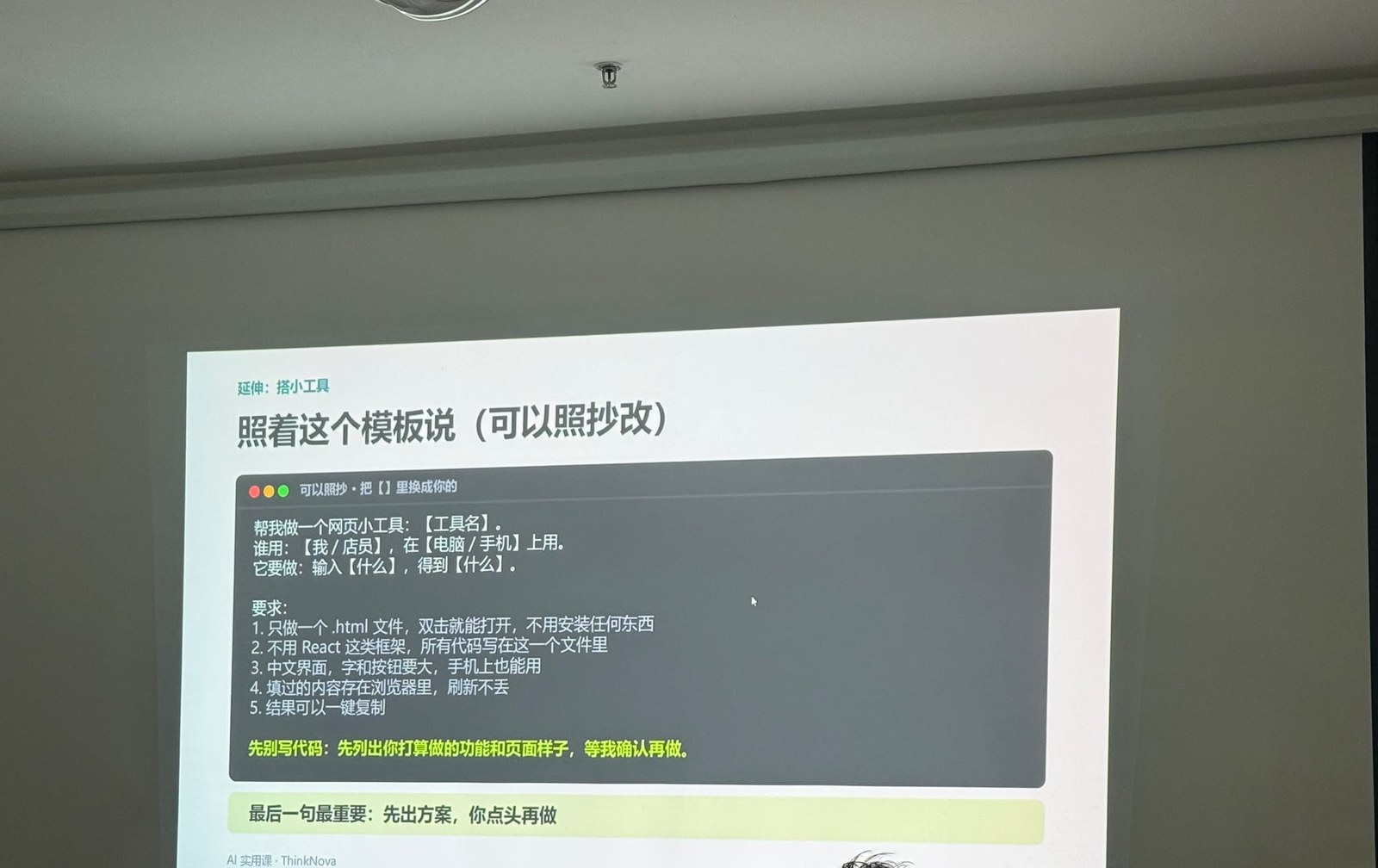
The last line of the template was highlighted, and it is the point of the whole slide: “Do not write code yet — first list the functions and what the pages will look like; wait for my confirmation.” The banner underneath read: “The last line matters most: propose first, build after I nod.”
Why these four steps matter
Because they turn “using AI” from a slogan into a checklist. What companies fear is not the absence of tools, but data that becomes untraceable after the tools run: who changed it, on what basis, and is the original still there. De-identify first, then organise, then spot-check, and keep the original — that order is exactly where efficiency and accountability balance.
Three directions I saw
- Individuals: photos, letters, chats, diaries — decades of one person’s records. Structure comes first, then preservation and handing on.
- Companies: client data, orders and work orders sit scattered across chat, email and spreadsheets; only after de-identification can they be handed to a tool.
- Boundaries: step four is not decoration. The spot-check is the only gate in the whole flow that keeps errors out.
A hands-on class follows: Thursday 22 October, 2 pm, Suntec City — free, bring a laptop and work along, with business AI consulting available after the class.

One thing I took away
On stage it was Codex; in the room it was a method for dividing work with machines. Tools handle the sorting; people judge, check and sign. I keep using that line in my own projects — today I simply heard it again, said more clearly than I had said it.
De-identify, organise, spot-check — and never throw away the original.

Want to turn scattered records into a proper file?
Start with one table you already use every week — and ask about our AI Agent course (two days, four core modules).