ZOOM Meetings · 22 Oct 2026
A Calligraphy Lesson: Chinese Culture in Twenty Characters
On 22 October, Rev. Tan Kok Hua demonstrated calligraphy at the Cornerstone Seniors’ Centre in Ang Mo Kio to twenty students. From holding the brush to copying the masters — a three-thousand-year discipline.
It Begins with Holding the Brush
On 22 October, Rev. Tan Kok Hua gave a calligraphy demonstration at the Cornerstone Seniors’ Centre in Ang Mo Kio, with twenty students present. It was one session in this year’s course; next, each student hands in a piece of work as their graduation project for the year.
Calligraphy is the art of writing Chinese characters with brush, ink and paper. From oracle bones and bronze inscriptions to seal, clerical, regular, running and cursive script, it has continued unbroken for more than three thousand years. It began as a tool for recording language and became a visual art of line, structure and rhythm — the same character, written with another hand, changes temperament.
Writing asks for clarity; calligraphy asks for something beyond clarity. Within one stroke there is pressure and lift, speed and slowness, wet and dry. Within one character there is centre of gravity, spacing, yielding. Across a whole piece, the breath has to connect. Learning usually begins with copying model books: follow the old masters until the hand remembers, then slowly let your own hand appear. It cannot be rushed, and it cannot be faked. Ten characters written carefully in a day are worth more than a hundred rushed in a week.
For older learners, calligraphy is excellent practice. Sit upright, lift the wrist, slow the breath, and attention has nowhere to go but the tip of the brush; an hour later the mind has quietened. Writing at the same table with others is also a form of fellowship — you look at another’s characters and see your own progress. Rev. Tan’s demonstration covered exactly the foundational skills: holding the brush, entering the stroke, moving it, and closing it.
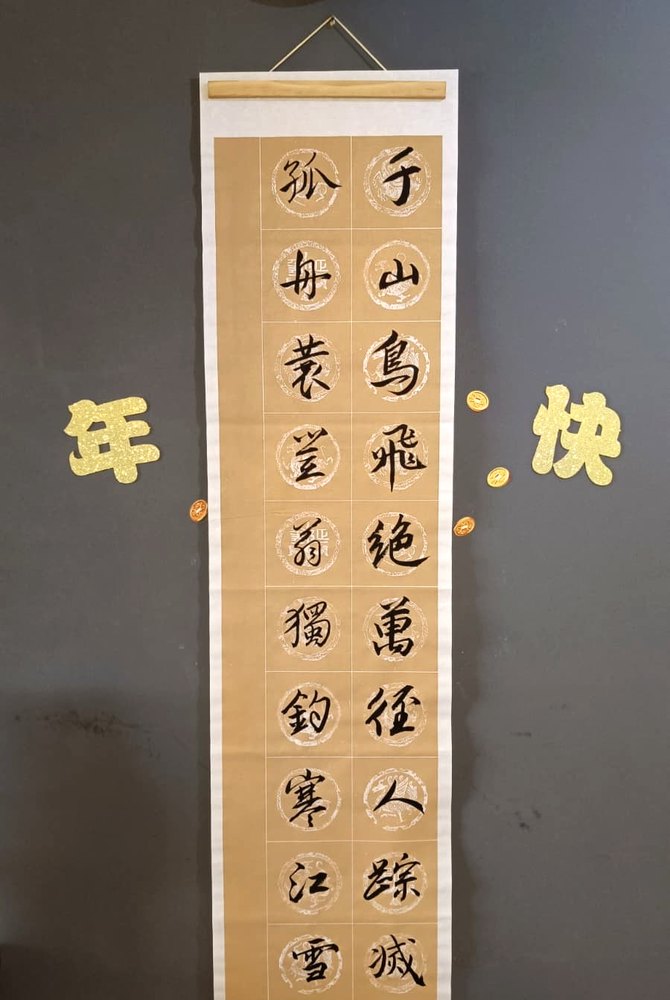
The piece in the photograph is “River Snow” — twenty characters, written by Liu Zongyuan after his exile. The characters sit in circular grids, orderly with a trace of running-script connection, like the stillness of a river after snow. The students’ assignment, perhaps, is to put that stillness onto a sheet of paper. Paper keeps the hesitation of the hand, and its certainty too.
Would You Like to Arrange a Cultural Session?
Contact us to discuss calligraphy, traditional culture and learning for older adults.