Education · Business
One business model canvas, and two markets for paid knowledge
Filling the AI Agent course into nine boxes, then comparing paid knowledge in Singapore and China.
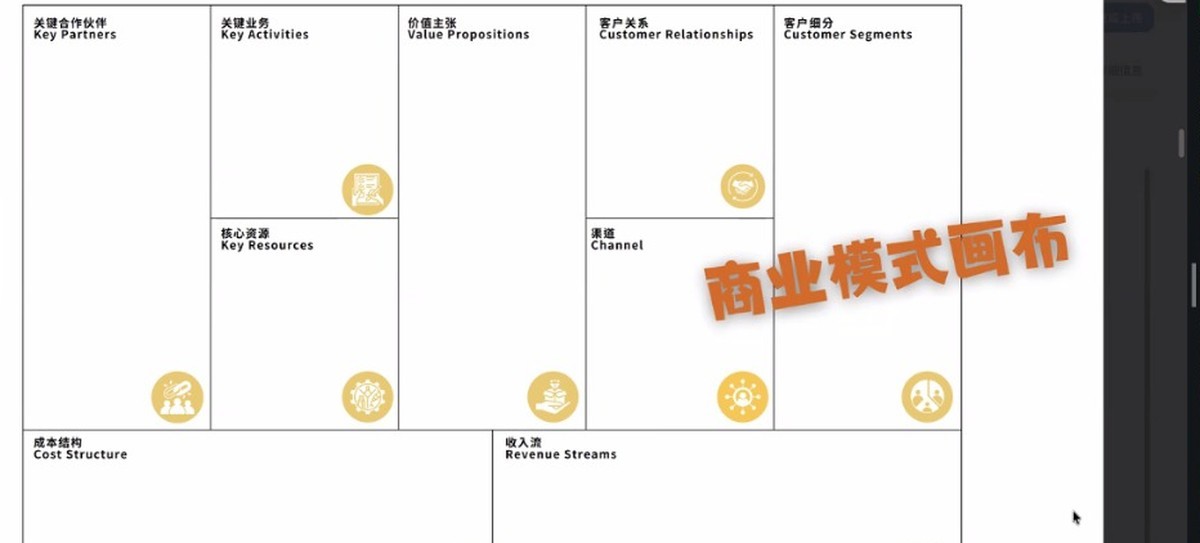
I spent a weekend in an online business model class. The teacher put a canvas on screen — nine boxes, with the words Business Model Canvas in the middle. Don't rush to fill it in, he said. Ask yourself each box in turn: in this one, what exactly keeps me alive?
1. Nine boxes, in fact a checklist
The nine boxes are an old framework: Customer Segments, Value Propositions, Channels, Customer Relationships, Revenue Streams, Key Resources, Key Activities, Key Partners and Cost Structure.
Its value is not innovation but forcing clarity. Many people can state a vision but not name their customer; can speak of passion but not of cost. Lay the canvas out and the vagueness shows immediately.
2. Filling it in with the AI Agent course
For the exercise afterwards, I tried it on our own AI Agent course.
Customer segments: SME owners, marketing and admin staff, educators and trainers, employees wanting to move. The common factor is not industry but this — every day there is one repetitive task.
Value proposition: we are not selling a tool but the ability to hand one repetitive task to an agent. Tools change; the ability stays.
Channels: the course page on our site, WhatsApp enquiries, referrals from past participants, offline talks. Singapore is small; referrals beat advertising.
Customer relationships: the hardest box. Post-course Q&A, case reviews, a monthly online gathering — without these, a course is just a one-off transaction.
Revenue streams: course fees, in-house corporate training, follow-on consulting. Three legs, not one.
Key resources: the curriculum, real cases, a working agent environment. Key activities: iterating the course, collecting cases, answering questions. Key partners: venues, chamber and church networks, payment and streaming platforms. Cost structure: time, recording, advertising, payment fees.
When I finished, the emptiest box was customer relationships, and the most overestimated was value proposition. Both are invisible — and both are the hardest to fake.
3. Singapore and China: two ecosystems of paid knowledge
The same class grows into very different things in the two places.
In China it is a traffic business: 9.9-yuan entry courses, referral chains, live-stream selling, flash sales. The playbook is: let a million people know you, then let ten thousand pay. Large scale, fast iteration, and plenty of refund disputes.
Singapore is a small market: about six million people, fewer still Chinese-speaking, so a traffic play does not scale. Paying here looks more like institutional procurement: invoices, tax treatment, a clear statement of what the course solves. The state subsidises adult training (SkillsFuture, WSQ and similar), and companies sending staff is more common than individuals paying for themselves.
The price structure differs too: China is low price, high frequency, volume-driven; Singapore is higher price, lower frequency, trust-driven. Where does trust come from? A clear syllabus, a verifiable instructor background, a proper invoice, and past participants you can actually ask.
Then there is compliance. Online courses count as digital services; above the turnover threshold you must register and charge GST (currently 9%). Advertising claims cannot be invented, and results cannot be overstated. China has rules too; the emphasis differs.
4. What we chose
The most practical reminder from the class: do not apply the China playbook to the Singapore market.
So on our course page, tuition, duration, dates and certification are all marked to be confirmed — not one unsettled number is printed. The seven course topics are spelled out so people can judge first. The enquiry channel is WhatsApp: ten minutes of conversation, and if it is not a fit, we say so.
After filling in the canvas, I realised what I actually want is not to sell more courses but for the people who come to actually use it. Scale is an outcome, not a goal.
Shall we talk about your box?
Course details and questions, WhatsApp +65 8134 8593.