Singapore · Life and policy
The engineering behind ten cents
Singapore's Beverage Container Return Scheme began on 1 April 2026 with a 10-cent deposit and Return Right machines. It looks like a barcode scan; in fact the machine checks four things before releasing the ten cents.
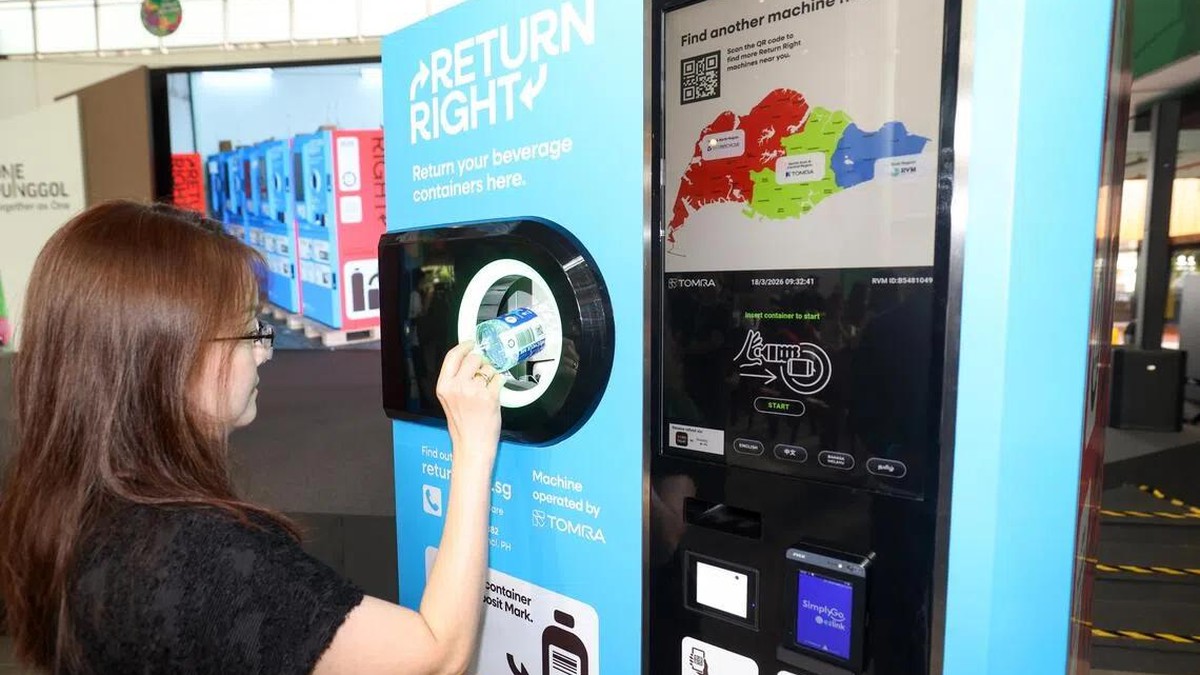
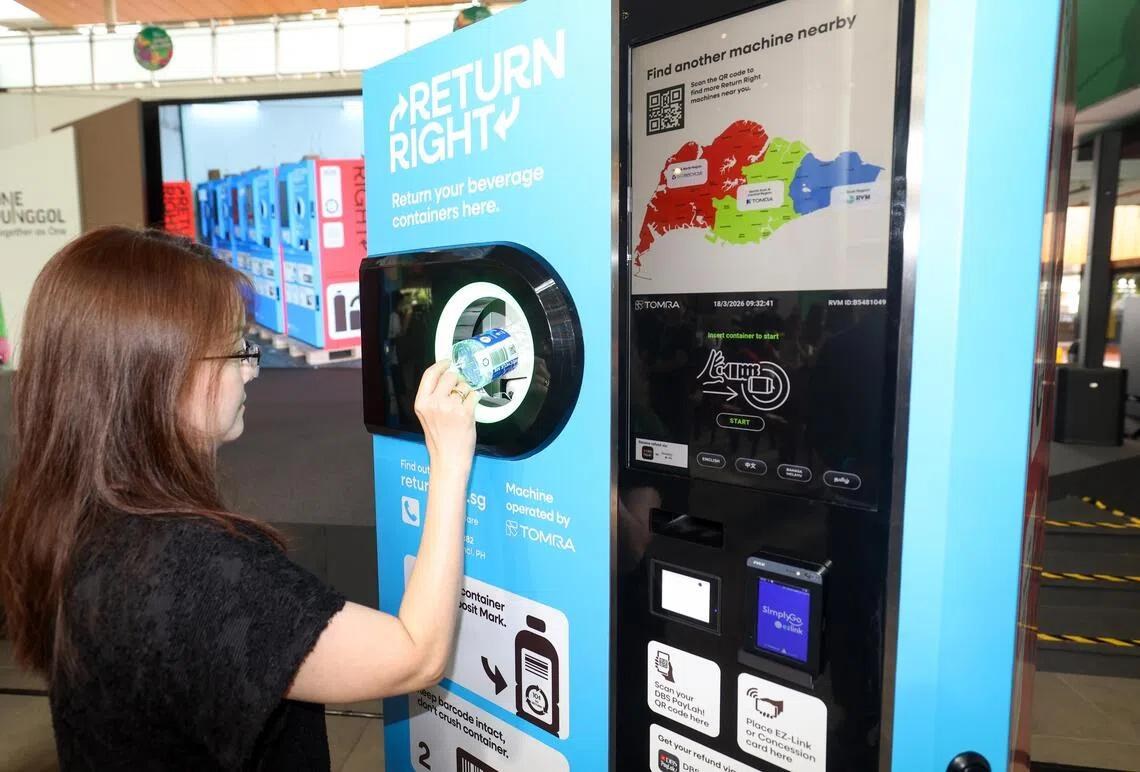
Outside the supermarket you push an empty bottle into the return machine, the screen blinks, ten cents goes back to your account. The whole thing takes about eight seconds. It looks as if the machine does one thing: scan a barcode.
The problem: thousands of bottles of the same drink carry the same barcode. A barcode says “which product this is”, not “which bottle this is”. If the machine trusted it alone, a printed barcode could, in theory, be exchanged for money.
1. What the scheme is
Singapore's Beverage Container Return Scheme (BCRS) began on 1 April 2026. Plastic and metal beverage containers from 150 ml to 3 litres carry a 10-cent deposit and a Deposit Mark; only marked containers can be returned at designated points and reverse vending machines (RVMs) for the refund. Refunds are digital, starting with EZ-Link cards including student and senior concession cards, with more routes to follow.
The operator is not the government but BCRS Ltd., a not-for-profit licensed by the National Environment Agency for seven years (April 2026 to March 2033). Its board draws on large and small producers: Coca-Cola Singapore Beverages, F&N Foods and Pokka, plus Wanin Industries and Chia Khim Lee Food Industries. It is an extended producer responsibility (EPR) scheme, Singapore's second after e-waste.
The scale is stated plainly: over a billion containers a year, more than 16,000 tonnes of material recoverable. The scheme came from a 2019 citizens' workgroup, aiming to raise household recycling rates and cut contamination in recycling bins. April to September 2026 is a transition period, with marked and unmarked bottles both on shelves.
2. What the machine actually checks
The industry's usual approach splits one deposit into four checks; fail any and the bottle comes back. First, the barcode: which brand, which size. Second, the Deposit Mark: whether it is present and where it sits — this decides whether a deposit was ever paid on that container.
Third, the container itself. Optical and three-dimensional profiling — on some models weight and material sensing too — compare the shape, volume and neck dimensions against a database for that SKU: a barcode claiming a 500 ml bottle but a 300 ml bottle arriving is rejected. This step cannot be copied with a barcode, because what must be copied is the bottle, not a sheet of paper.
Fourth, condition: the bottle must be empty, drained and legible. Residual liquid interferes with optical reading and fouls the machine; crushed bottles or removed labels usually fail. Some machines also cap returns per account per day, to stop bag-loads being fed in.
So the machine does not recognise “a bottle”; it recognises which bottle, and confirms it currently looks like that. The first comes from a database, the second from sensors — which is why these machines contain not a scanner but cameras, weighing and a conveyance mechanism.
3. The suspected misuse, and what the report did not say
Lianhe Zaobao recently reported a suspected case of machine misuse. A BCRS spokesperson said the machines had since been recalibrated together with the return point operators. The report did not say whether improper refunds were actually obtained, and a single video cannot show how common such cases are.
The distinction matters. Recalibration suggests recognition parameters may have drifted; but drifted parameters and someone actually extracting money are two different things. The first is an engineering question, the second an evidentiary one — answered by backend logs, refund records and footage, not by a circulating clip.
4. Why ten cents deserves the trouble
Ten cents is less than a tenth of a coffee, but it is a behavioural switch. Deposit schemes have run for years in Norway, Denmark and Lithuania with return rates around nine in ten — not because people suddenly love the environment, but because not returning means losing money. In economics, it puts an external cost back in an individual's hand.
For families there is a side effect: children take it more seriously than adults. Letting them feed the bottle in and watch the number change does more than ten lectures on recycling. It is a point we often make in international education — habits are not built by exhortation but by a mechanism with visible feedback.
5. A few practical notes
One, check the mark: only containers with the Deposit Mark can be returned, and during the transition both kinds are on sale. Two, empty it: a mouthful left counts as residue and will be rejected. Three, do not crush it: the 3D profile will not match and the machine treats it as the wrong container. Four, watch where the refund goes: EZ-Link is the main route for now, with QR routes rolling out — a missing credit is not necessarily a broken machine.
As for whether the machines can be gamed, the answer is probably the same as for any automated system: people will try, and the system will be patched. What decides the scheme is not how clever the machine is, but whether most people are willing to spend those eight seconds.
New to Singapore and unsure how things work?
WhatsApp +65 8134 8593 — we answer what we can, and find someone who can for the rest.