News · AI
One person, one film
From a food-court conversation to a Hollywood camp: AI has removed the need for a crew; what remains is story, judgement, truth and boundaries.
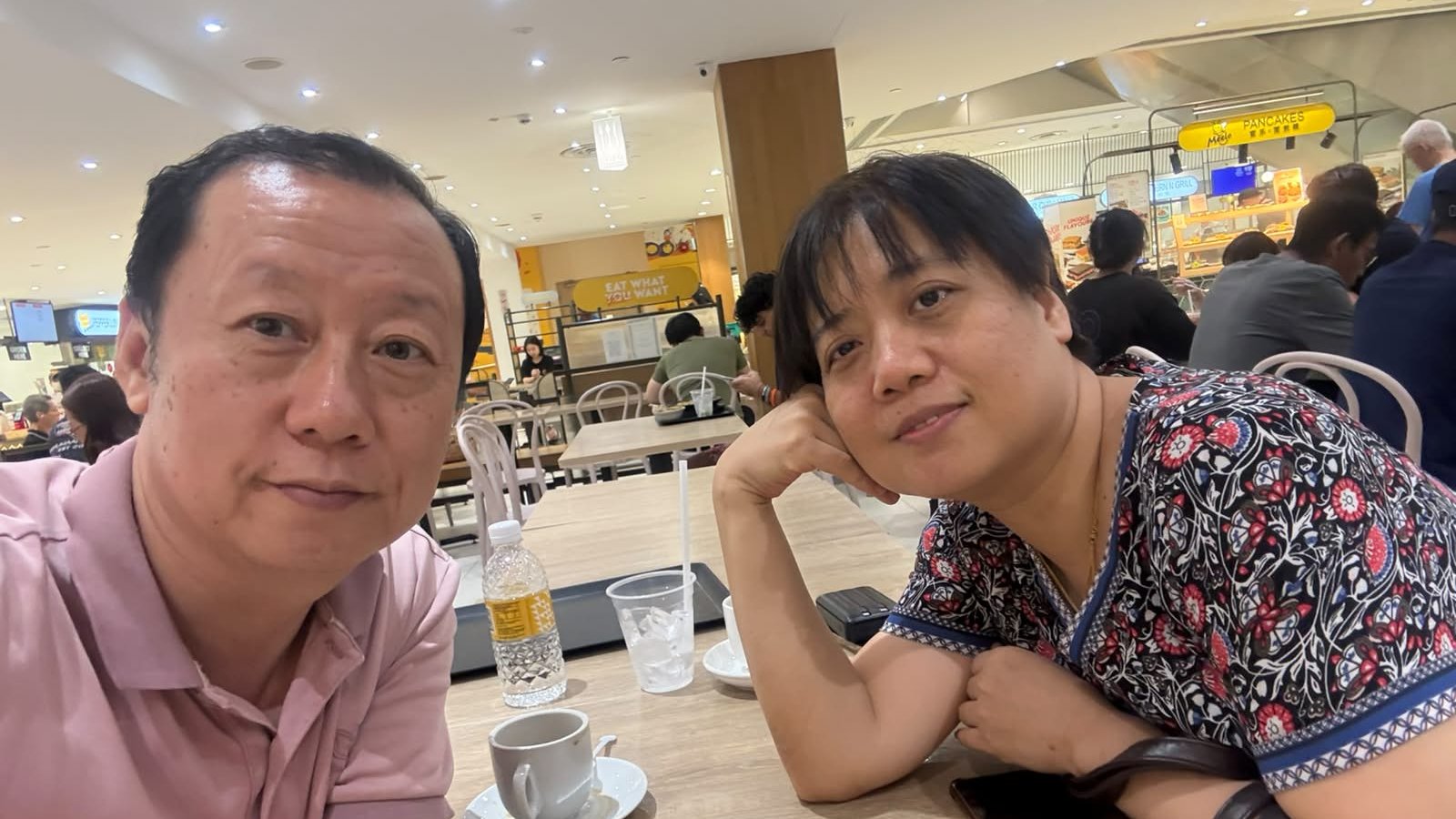
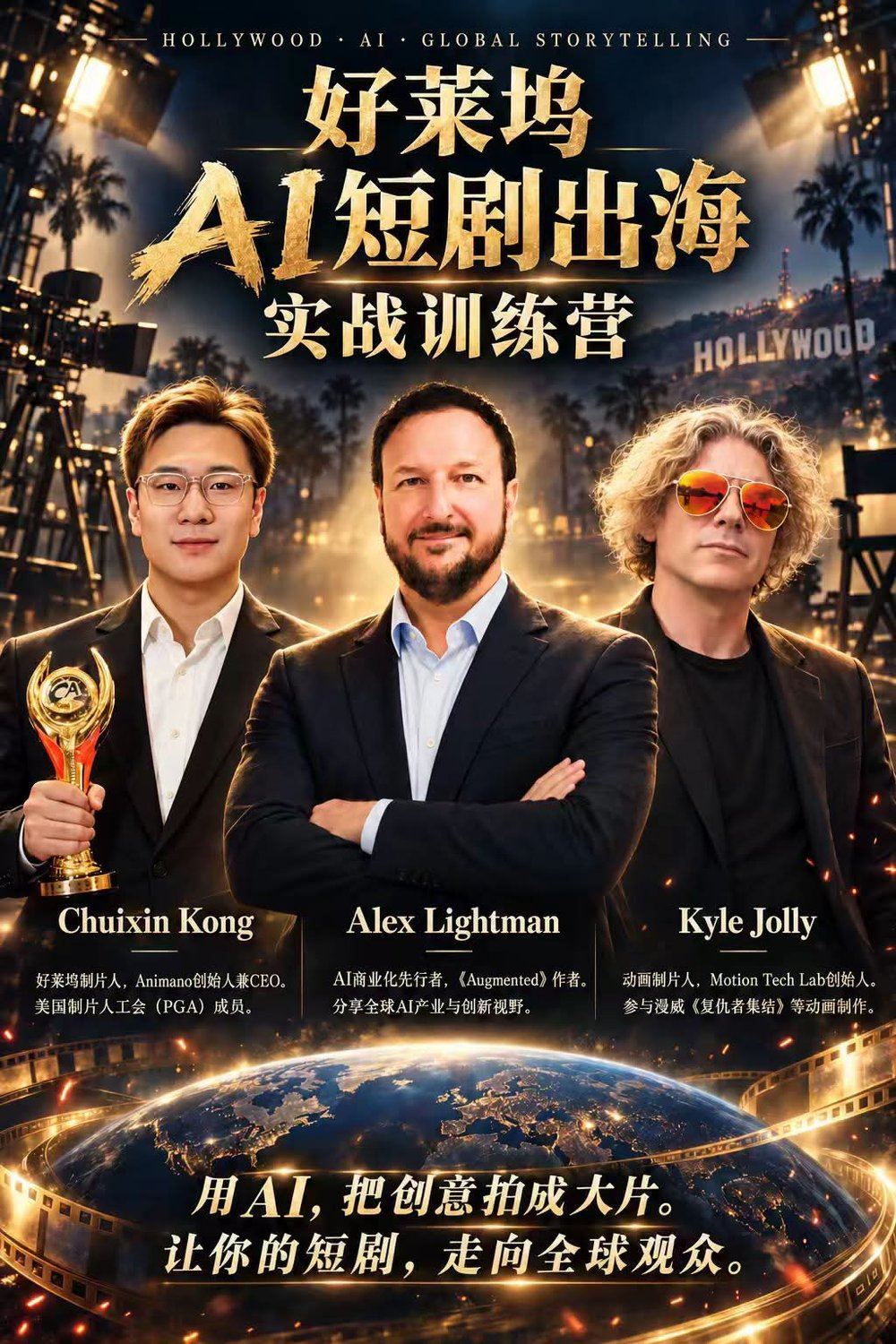
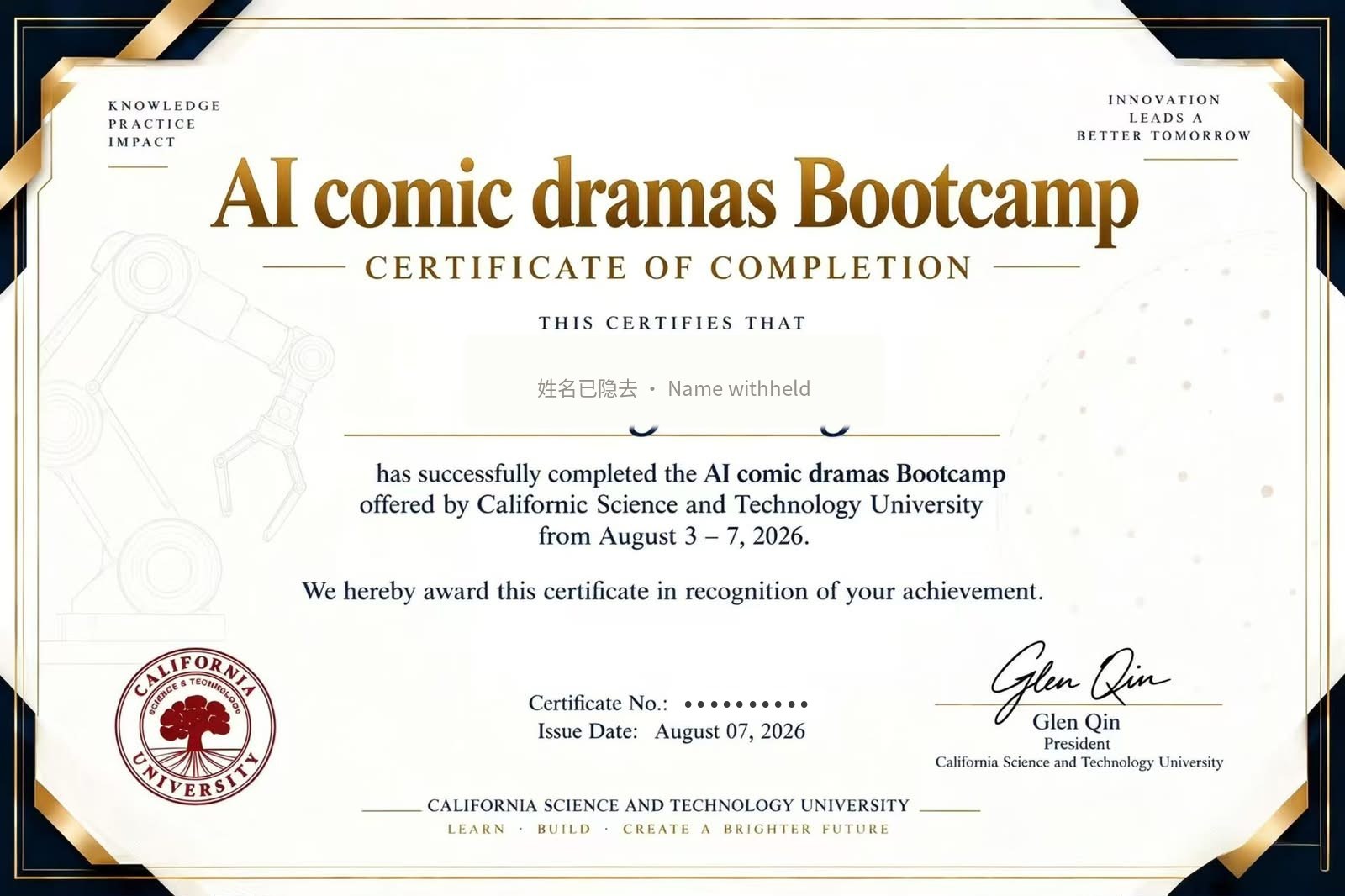
Three things from one afternoon belong side by side: a photo from a food court in Bukit Timah, a poster for a Hollywood AI short-drama camp, and a certificate of completion. They say the same thing — AI is turning “making a film” from something that requires a crew into something one person can begin.
Over a late lunch at a food court in Bukit Timah, I talked about this with Ms Su Chuqi. She is General Manager of ASPA Consulting Pte Ltd, Executive Assistant Director of Toastmasters District V (2026–2027), Treasurer of Soroptimist International of Singapore (Orchid), and Media Director of the Hongxiangling Art Association. Four roles spanning corporate consulting, public speaking, women's service and arts communication — someone who speaks on stage and organises behind it knows exactly where content gets hard: everyone has ideas, few can get them made.
1. The barrier used to be in the budget
Making a film used to mean a budget line for everything: director, camera, lighting, sound, cast, location, post-production. A five-minute story sat on dozens of people's calendars and a sum of money. Most good stories therefore stopped at “I thought about it” and never reached “I shot it”.
2. One person can now have a crew
What changed in the last two years is this. Generative models produce images and voices, and AI agents break one large task into a chain of small ones and carry them forward: write the script, list the shots, generate them one by one, add narration and music, cut it together on a timeline. You no longer need to remember where every button sits — you state the requirement clearly and point at what is wrong, and it goes again. The tool has moved from “a pen in your hand” to “an assistant at your side”.
A new way of producing appears: a crew of one. One person writes the story, sets the style, decides which shot cannot be used. The work does not vanish; it is compressed into what one person can carry. For an elderly member of a church, a community group, a small shop owner, that means a chance to film what they care about — without waiting for a TV crew.
What does that mean in daily life? A church can record its elders' oral history; a community group can turn one event into a three-minute recap; a small shop can film “why I do this work”. These subjects were never unimportant — they were simply not worth assembling a crew for a five-minute piece. Now they are.
Walking through it in five days looks roughly like this: day one, story and characters; day two, break the script into shots; day three, generate each shot and keep the usable ones; day four, voice, music and subtitles; day five, edit, fix the pace, export. Every step loops back, but every step shows something the same day — the sharpest difference between an AI workflow and the old one: feedback moves from “in a few weeks” to “in a few minutes”.
3. What the camp teaches
The positioning is explicit: Hollywood, AI, global storytelling. So are the three speakers' roles — Chuixin Kong, Hollywood producer, founder and CEO of Animano, member of the Producers Guild of America (PGA); Alex Lightman, an early mover in AI commercialisation and author of Augmented, on the global AI industry and innovation; Kyle Jolly, animation producer and founder of Motion Tech Lab, with credits on Marvel's Avengers Assemble and other animation. One covers production, one the industry, one animation — roughly the three stages from idea to finished cut to overseas release.
Short drama suits AI by nature: vertical, episodic, one or two minutes per episode, fast-paced, no need for grand sets. What costs most in the traditional process is unpredictability — cast availability, location, weather, reshoots. AI turns part of that into drafts you can revise: storyboards as images first, scratch voice tracks, a shot you dislike simply redone, at the cost of time rather than money. This does not shrink cinema; it makes “getting it made” cheaper.
4. What the certificate actually shows
The certificate tells no story of its own. It says one thing: someone actually finished the course, five full days from 3 to 7 August. For a toolset that changes generation every few months, five days cannot teach everything, but it is enough to cross the “I don't know where to start” line. We hid the name because the certificate belongs to a person; the course information is enough — which is also how we handle anyone's material: publish only what is necessary.
5. Going global was never about shooting
The real barrier in “going global” comes after the shoot. First, language and voice: subtitles, delivery, tone — a small gap and the audience is thrown out of the story. Second, platform rules: what content is allowed, whether AI-generated material must be labelled, whether licensed music can be used. Third, likeness and material rights: whose face, whose voice, whose footage — there must be a basis for it. Fourth, distribution: the same film may find viewers on one platform and fail even to be recommended on another. AI replaces none of these four.
6. What is actually scarce
Once the barrier drops, what is scarce becomes clear. First, story: tools generate images but cannot generate why this particular thing must be told. Second, judgement: choosing one shot from a hundred is taste and experience, not a prompt. Third, truth: AI can synthesise a face and a voice, but what an audience remembers is the moment it was actually moved. Fourth, boundaries: use someone's photo, voice or work only with consent; label AI-generated content where platforms require it; never put words written by AI into a real person's mouth.
My reading of AI film is this: it does not remove the work, it removes the requirement of a crew. What remains are the old questions — what do you want to say, what gives you the right to say it, and will anyone want to listen. Technology hands those three questions back to the storyteller.
If you would like to turn something you care about into three to five minutes, come and talk. We teach in Chinese, starting from the phone.
About the interviewee
Su Chuqi
· General Manager, ASPA Consulting Pte Ltd
· Executive Assistant Director, Toastmasters District V (2026–2027)
· Treasurer, Soroptimist International of Singapore (Orchid)
· Media Director, Hongxiangling Art Association
Want your story in three to five minutes?
We teach in Chinese, starting from the phone. Courses and one-to-one consulting: WhatsApp +65 8134 8593.